

To dry tea herbs, snip them just before you need a trim, bundle small handfuls, and hang them upside down somewhere dark, dry and airy until the leaves crumble when you pinch them. Store the leaves whole in an airtight jar away from light, and crush them only when you brew. That's the whole method. The rest is timing.
Fresh-picked will always be the brightest cup. But your plants don't wait for your tea schedule, and a jar of your own holy basil on a winter night is its own kind of luxury.
At a glance
-
Best for drying: sturdy, aromatic leaves like holy basil, spearmint, sage, thyme, orange thyme and oregano, plus calendula and marigold petals
-
Better fresh: lemon balm and Thai basil lose much of their brightness when dried; dry them anyway if you have extra, but brew them fresh when you can
-
Air drying: about 1 to 2 weeks
-
Done when: leaves crumble, stems snap
-
Brewing dried: use about a third as much as fresh
When to harvest for drying
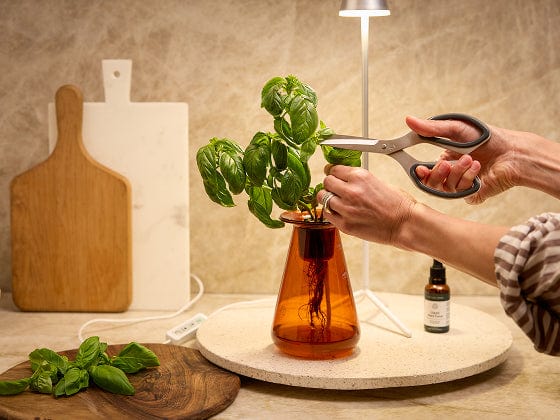
Harvest when the plant is full and leafy, ideally right before it starts to flower. That's when leaves carry the most flavor. Snip in the morning, before your grow lights or the afternoon sun have been on the leaves for hours.
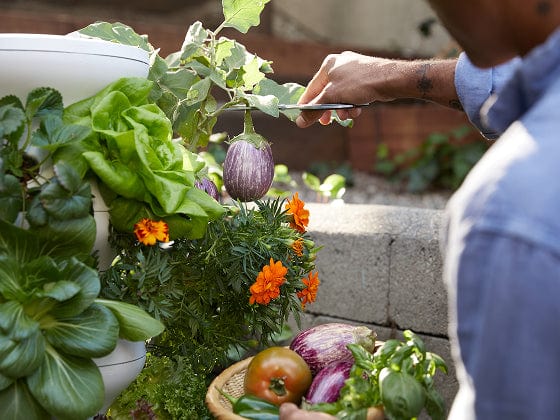
The good news: harvesting for drying is the same as a regular trim. You're cutting the plant back so it grows fuller, and keeping the clippings instead of tossing them. (Our harvest guide shows exactly where to cut.)
Three ways to dry
Hang them (best for long stems). Gather 5 to 8 stems into a loose bundle, tie them with twine, and hang them upside down out of direct sunlight. Keep bundles small so air reaches the middle. A pantry, a closet with the door cracked, or a hook by the window (not in the sun) all work. Expect 1 to 2 weeks.
Lay them flat (best for leaves and flowers). Spread single leaves, calendula petals, marigold petals or viola flowers on a screen, a baking rack, or a plate lined with a paper towel. Turn them every day or two. Flowers usually dry in under a week.
Use the oven or a dehydrator (fastest). Set the oven to its lowest temperature, spread herbs on a sheet pan, and prop the door open a crack. Check every 15 minutes; most leaves take 1 to 4 hours. A dehydrator on its herb setting does the same thing with less watching. Low heat matters: too hot and the aromatic oils that give your tea its flavor bake off.
How to tell they're ready
Pinch a leaf. If it crumbles, it's done. If it bends, give it another day or two. Stems should snap, not flex. Anything that still feels leathery can grow mold in the jar, so when in doubt, wait.
How to store them
Strip the dried leaves from the stems and keep them as whole as you can. Whole leaves hold their aroma far longer than crushed ones. Pack them into an airtight jar, label it with the herb and the date, and store it somewhere cool and dark. Amber glass helps here, since light fades both color and flavor.
Dried herbs taste best within about 6 months and are still good for a year. When a jar smells faint, it's time to harvest again.
How to brew dried herbs
Dried herbs are more concentrated, so use about a third of the fresh amount. For Nightfall, that's roughly 1 heaping tsp each of holy basil and lemon balm and a little over half a tsp of dandelion, instead of 4, 4 and 2. Crumble the leaves into your infuser right before the water goes in, then steep as usual.
Our tea blends are written in parts for exactly this reason. Keep the ratio, swap fresh for dried, and the blend still works.
Make your own house blend
Once you have a few jars, you have an apothecary. Mix dried holy basil, orange thyme and Thai basil for a jar of Fireside, or spearmint, thyme and sage for Deep Breath, and you've got a pot of tea ready for the coldest nights of the year.