

Why the produce aisle isn't always as fresh as it sounds, and what to grow this month.
We call an entire section of the grocery store “fresh produce.” Which is a little strange when you think about it. The lettuce might have been harvested a week ago. It may have traveled 1,500 miles, passed through packing facilities and distribution centers, and spent days on a grocery store shelf. Some packaged greens are designed to last in a clamshell for as long as three weeks. And we still call them fresh. Mostly because they were once alive.
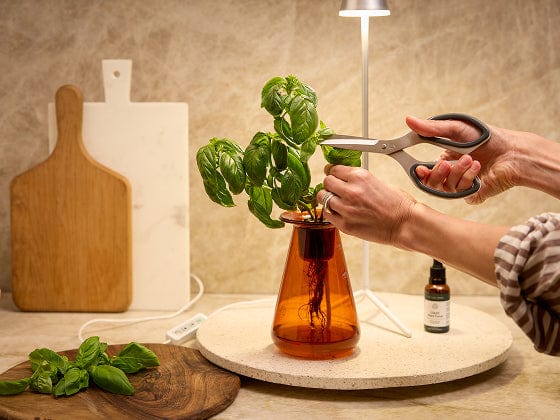
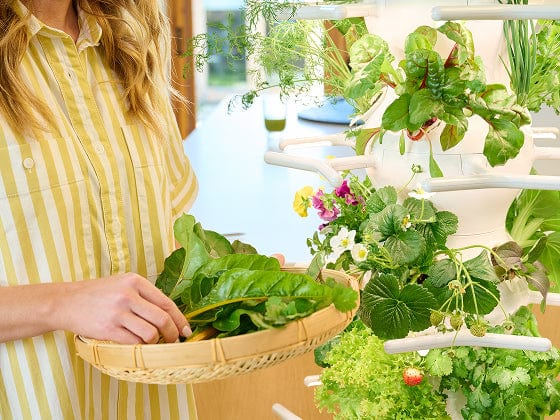
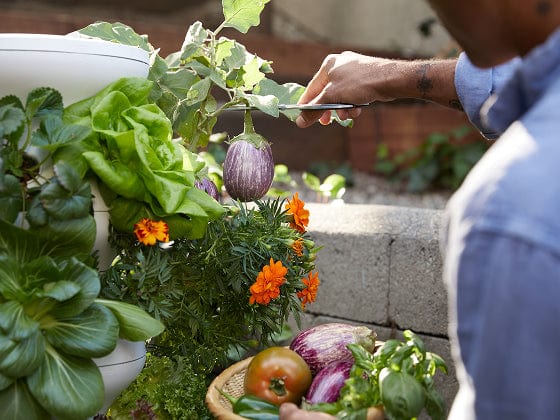
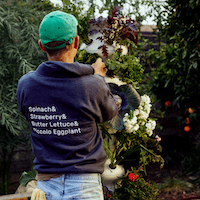
Growing your own changes that definition completely. The lettuce on your Farmstand isn't waiting to be eaten. It's still growing. Still taking in water and nutrients. Still alive. You can harvest it while you're making dinner and eat it minutes later. That's not just a fresher version of the same thing. It's what fresh was supposed to mean in the first place.
What your produce loses on the way
Once a vegetable is harvested, the clock starts. Nutrients begin to decline after harvest, affected by time, temperature, light, and handling.
And the change can happen surprisingly fast. Vitamin C is one of the nutrients researchers commonly use to measure that decline. Studies following lettuce through transportation, storage, and retail conditions have found significant losses within just a few days. Research on salad greens has found the same, with spinach losing substantial amounts during refrigerated storage.
And here's the strange part: the lettuce can still look fresh. We've gotten very good at keeping produce crisp, green, and appealing for a long time after harvest. But extending shelf life isn't the same thing as preserving everything that was in the plant when it was picked.
So the lettuce in your fridge may look much like it did on harvest day. Nutritionally, it may not be quite the same lettuce.
That's one of the less obvious advantages of growing food at home. You're not just shortening the distance between the plant and your plate. You're shortening the time between harvest and eating it.
And that difference can be measured. When we tested lettuce grown on a Lettuce Grow Farmstand against grocery store lettuce, ours had 76% more micronutrients. Freshness isn't only something you can taste.
A much shorter food chain
There are a lot of steps between a commercial farm and your refrigerator. Produce can move through harvesting crews, packing facilities, trucks, distribution centers, grocery stores, stockrooms, shelves, and finally your kitchen. Each step adds some combination of time, handling, and temperature changes.
Growing at home collapses most of that chain. You know where your food grew. You know what went into it. You know who handled it. And you know exactly when it was harvested, because you're the one who picked it.
The distance between farm and table can quite literally become a few feet.
This is a pretty good month to close the gap
September is National Fruits & Veggies Month, which feels like a good excuse to add something new to the Farmstand. The usual advice is to “eat more vegetables.” Good advice. Not always particularly useful advice.
Because eating more vegetables usually depends on something else first: having vegetables around that are fresh, appealing, and easy to grab at exactly the moment you're deciding what to eat.
That's one of the things we love most about growing at home. When lettuce, herbs, and vegetables are already growing a few steps from the kitchen, eating them requires a lot less planning. “I should eat more plants” becomes “I should probably pick that.” And then you do.
Our pick for September: watercress
If we had to name one plant on the Farmstand that pulls the most weight for its size, watercress would be high on the list. It doesn't get nearly the attention kale or spinach does. By the numbers, it probably should.
In a CDC-published study ranking “powerhouse” fruits and vegetables by nutrient density, watercress came out on top with a perfect score of 100. Kale, for comparison, scored 49.
Watercress packs quite a bit into a very small leaf:
-
It's an excellent source of vitamin K, which supports normal blood clotting and bone health.
-
It's a cruciferous vegetable, in the same family as kale and broccoli, and contains the glucosinolate compounds characteristic of that family.
-
It contains vitamins A and C for around 4 calories per cup.
-
It's also a source of calcium and folate.
But we don't grow it because it won a nutrient-density contest. We grow it because it's really good. Watercress is peppery and a little sharp, and it works just as well tucked into a sandwich as it does tossed into a salad or blended into a dressing.
It's also one of those plants that makes a particularly good argument for growing your own. Watercress is delicate after harvest and can be harder to find really fresh at the grocery store.
When it's growing a few feet from your kitchen, that's not much of a problem.
Try it in: the Bend Power Bowl, Chef Sammy Monsour's Pacific Northwest-inspired salad of Farmstand greens, apple, toasted hazelnuts, and blue cheese. Apple, hazelnut, and blue cheese are a great match for watercress's peppery bite. Swap in a couple handfuls for the arugula, or add it alongside.
Grow the distance down to zero
Once you've eaten lettuce that was still growing when you started making dinner, the definition of “fresh” changes a little.
No truck. No warehouse. No produce aisle. No wondering how long ago it was harvested. Just plant, pick, plate. The freshest lettuce isn't the lettuce that got to the grocery store fastest.
It's the lettuce that never had to go anywhere at all.